Revenge Bedtime Procrastination for ND Adults | NeuroDiversion

Revenge Bedtime Procrastination for ND Adults

Mini Case Snapshot

It's 11:47 p.m. You promised yourself lights out by 11:00, but you finally feel human for the first time all day. One more scroll turns into one more video, then one more task. Morning still arrives on time.

Quick Start Guide

Use this tonight. Name your pattern first: decompression, doomscrolling, unfinished-task anxiety, or time-blind drift. Then choose one finite shutdown anchor and start it before you're exhausted.

Last-call alarm: 45 minutes before bed

No-new-tasks rule: when alarm rings

Wind-down length: 30 minutes minimum

Morning anchor: same wake time

Introduction

Revenge bedtime procrastination is what happens when your need for autonomy and decompression wins over sleep timing. For many ND adults, it doesn't come from laziness. It comes from a day that asked for constant output without enough recovery.

The target isn't "perfect sleep hygiene." The target is a repeatable evening system that protects your freedom and your next-day capacity.

What It Is

At a practical level, bedtime gets delayed without an external blocker. Inside the moment, it feels like "I finally have time for me." The behavior is understandable. The cost shows up the next morning as lower tolerance, lower focus, and harder task starts.

If executive function friction is already high, the short-sleep hit is usually bigger. Pair this page with Executive Dysfunction for daytime planning changes that reduce the night rebound.

Why ND Brains Get Pulled In

Daytime masking, context switching, and sensory filtering can leave your system activated late. At the same time, nighttime is often the first low-demand window, so your brain treats it as protected territory.

ADHD patterns can add time blindness and second-wind hyperfocus. That's why "I'll sleep in 20 minutes" can quietly become two hours.

This talk from Jessica McCabe explains how ADHD support systems can be built around real-world friction rather than ideal routines.

Strategies That Hold Up

Protect some reclaim time before late night so your brain doesn't need to steal all of it at 11:30. Then use a two-stage shutdown: power-down first, sleep prep second. This reduces transition shock and keeps your routine from depending on midnight willpower.

On hard weeks, run a "minimum viable bedtime" instead of quitting the plan: bathroom, meds if prescribed, phone docked away from bed, lights out. Low friction beats all-or-nothing.

Hard Night Timeline

T-45 minutes

Last-call alarm. No new tabs, no new projects.

T-30 minutes

Start a finite wind-down ritual with a clear end.

T-10 minutes

Phone docked, light low, tomorrow queue captured.

Morning

Keep wake time, get early light, reduce shame script.

What Not To Do

Don't build a plan that removes all evening joy. It won't hold. Don't treat one late night as evidence that your system is broken either.

Avoid extreme catch-up sleep swings on weekends when possible. Big shifts usually make Monday nights harder.

When Professional Help Helps

Bring in support when bedtime delay is chronic and your days are unraveling. Sleep medicine, CBT-I informed therapy, and medication-timing review can make a real difference.

A simple two-week log of bedtime, wake time, and delay trigger gives clinicians enough signal to personalize next steps quickly.

Conclusion

You can protect nighttime agency and still sleep enough to function. Start with one earlier reclaim block, one last-call alarm, and one morning anchor. Small shifts compound fast.

Build A Better ND Baseline

Browse more guides on recovery pacing, executive function, and low-friction daily systems.

Go To Home

References

  1. Kroese FM, De Ridder DTD, Evers C, Adriaanse MA. Bedtime procrastination: introducing a new area of procrastination. Frontiers in Psychology. 2014;5:611.
  2. Diaz-Roman A, Mitchell R, Cortese S. Sleep in adults with ADHD: systematic review and meta-analysis of subjective and objective studies. Neuroscience & Biobehavioral Reviews. 2018;89:61-71.
  3. Watson NF, Badr MS, Belenky G, et al. Recommended amount of sleep for a healthy adult. Sleep. 2015;38(6):843-844.

This article is for informational purposes only and is not medical advice.

Last updated: March 2, 2026
Questions & Adventure

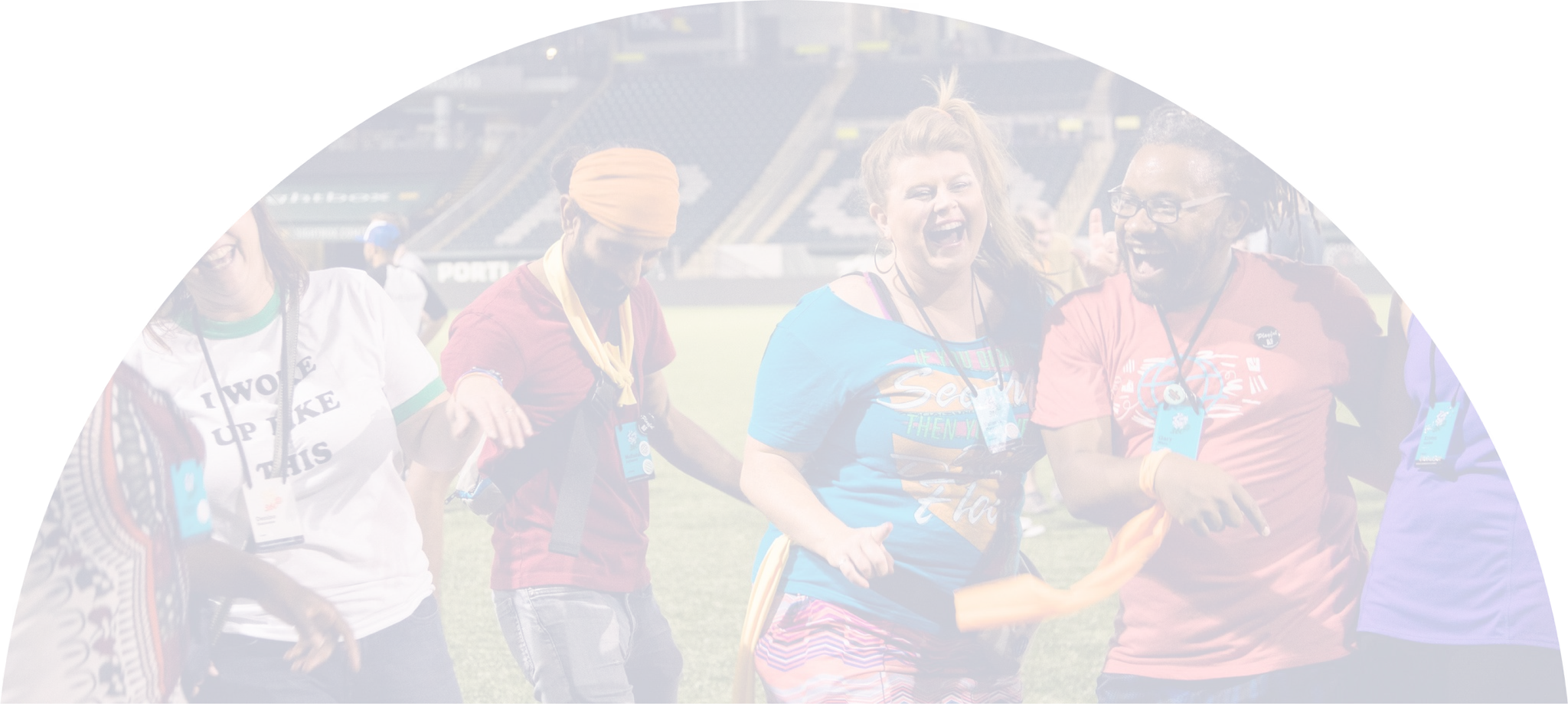
After two successful events, we're confident there's nothing else quite like NeuroDiversion. Other events focus on clinical education or academic research—we're built around community, lived experience, and the joy of being around people who just get it.

We'll be using multiple venues in Austin for ND27, including Fair Market—a beautiful event space in East Austin close to many restaurants and hotels. It's 15 minutes from the airport and you won't need a car unless you choose to stay farther away.

Not just before, but also during and after! At least a few weeks before the event, you'll have access to an app that allows you to browse attendee interests and make initial connections.

Once the big week arrives, programming details will be added, so you can choose which activities to attend and easily make new friends.

(We think you'll like the app, but if you prefer to opt out of being listed in it, you can do that too.)

ND27 ticket pricing will be announced later this year. Join the waitlist to be notified when registration opens.

NeuroDiversion is hosted by Chris Guillebeau, bestselling author and founder of the World Domination Summit, an annual event in Portland, Oregon that brought together thousands of people for a decade.

The planning team has years of experience producing WDS and other events.

Almost everyone on the planning team has personal experience with ADHD, ASD, or another neurodivergent type—we didn't come to this idea out of academic interest.

That means we design the event differently. Sensory sensitivities are taken seriously. You'll find quiet spaces, clear signage, and a flexible schedule that lets you step away whenever you need to. Talks are short. Breaks are real. Nothing is mandatory.

This is a gathering of people who understand social challenges firsthand—you can be as passive or active as feels right to you.

Think of our schedule as a flexible framework. Each day has anchor points (two sessions where everyone comes together) that provide rhythm, but what happens between those points is up to you.

Want to attend every scheduled breakout or workshop? Great! Need to skip something for alone time or an impromptu conversation? Also great! We'll use a simple app to help you track what's happening when, but you're never locked into anything.

We design every NeuroDiversion event with overwhelm in mind. You'll find quiet spaces throughout the venue where you can decompress whenever needed. The schedule includes natural breaks between sessions, but you're always free to step away for extra time if you need it.

No explanation necessary—we get it. We'll clearly mark the quieter areas of the venue so you can easily find a spot to reset.

For ND27, we'll be working with hotel partners close to the main venue. We'll share discount booking codes with attendees at least three months in advance of the event.

Older kids and teens, definitely! And not just attend—they can also participate. There will likely be a few sessions that are appropriate only for adults, but the great majority of programming will be family-friendly.


Absolutely—and you won't be alone in feeling this way. We're creating multiple paths for connection that don't require traditional networking. You might enjoy joining a meetup where the focus is on doing rather than talking, or you might prefer to observe from the sidelines.

This is a gathering of people who understand social challenges firsthand, so you can be as passive or active as feels right to you.

You can do that if that's all you can get away for, but there's only one ticket option. You'll enjoy the experience much more if you stay for the whole three days, like most attendees.

Yes! We offer a package of continuing education (CE) credits for clinicians in attendance. Details and pricing for ND27 will be announced with registration.

Possibly! Many employers support personal development opportunities like NeuroDiversion, and some of our attendees have already had success getting their costs covered.

Your company and organization may already have a process for this, but in case it's helpful, we've made an employer letter template you can use to support the request. Be sure to copy the template into a new document so you can customize it with your details before submitting. :)


Maybe! But first, note that we're doing everything possible to keep costs low while putting together an exceptional experience. Most of our team are volunteering their time and labor, including our founder and all speakers, and we rely on ticket sales to fund the experience.

That said, we do want to provide a few scholarships to help those who wouldn't otherwise be able to attend. Fill out this form if that might be you.

We'll open applications for ND27 community programming later this year. Join the waitlist and we'll let you know when submissions open.

How rude of us! But we'll fix that: send us an email at team@neurodiversion.org

Sound Interesting?

Join the list to be the first to hear about ticket sales!

© 2025-2026 All rights reserved.